I think it's fairly obvious from this website that I'm into art. Those who know me certainly know it. I have no artistic talent myself, but I've been lucky enough to be surrounded by creative and talented people from a young age, both within my family and among my friends.
At university, I took a minor in Art History and loved almost every minute of it. One notable exception was my course on ancient Greek art and architecture. The instructor, whose name I can no longer remember, was one of those teachers who were clearly qualified but so uninspiring it was almost tragic. It happens. What can you do? Perhaps take note of how not to teach, if you're interested in teaching…
Anyway. I firmly believe that often the best writing prompts don't come from a textbook. They come from a piece of art. Indeed, one painting can become the starting point for several different activities, adapted to the needs and confidence of the class.
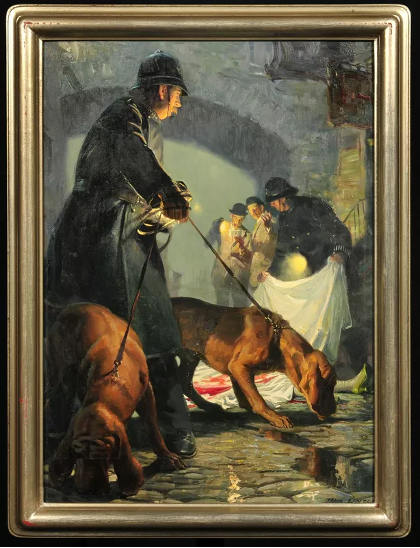
In my Short Stories unit, after studying crime fiction, I use the above painting, The Crime Scene (1956), by American artist Tom Lovell, to help pupils explore descriptive writing, atmosphere and storytelling.
The painting depicts a body lying in a dark, foggy street, surrounded by policemen, detectives and two large dogs. It has all the ingredients of a crime story, yet it leaves us with more questions than answers. Who was the victim? What happened? Who are the people gathered around the body? What might they be thinking? And what happened just before this moment — or what might happen next?
Start with what you can see
Before asking pupils to invent a story, I like to give them time to look carefully at the painting.
What can they actually see? What can they infer? Which details stand out? How would they describe the setting, the people and the atmosphere?
These questions encourage pupils to move beyond simply listing objects in a picture. They begin to think about the effect of details and the language they need to communicate what they see.
For pupils who are less confident, particularly those in the traditional section, I use a simple worksheet with prompts about the figures, the setting and their personal response to the painting. Sentence starters and guided questions provide a framework, helping them organise their observations and find the words to express them.
The aim isn't to restrict their imagination. It's to give them a way in.
Looking closely, describing precisely
Another approach is to ask pupils to focus on one particular part. Anything that stands out to them. This gives students an opportunity to practise oral expression before putting their ideas on paper. It also encourages them to notice details they might otherwise overlook and to think about how to communicate those details clearly to an audience.
They might describe the figures, the dogs, the street or the buildings in the background. They can then share their descriptions with the class. I am always amazed at what different people focus on: from the time of day to the surrounding buildings and what lays through the archway, the clothing, the dog breed and their expressions, or the victim’s shoe.
The runner challenge: Can words recreate a picture?
This is one of my favourite ways to use the painting.
We split the class into several teams. Each team selects one pupil to look at the painting on my computer for 45 seconds. They then return to their group and describe what they remember, while the others use that information to write a detailed descriptive paragraph. The process is repeated three or four times. The runner can be the same student each time or a different one, each team can decide what they prefer. Depending on the class, I give around 5 to 10 minutes to complete the paragraph.
At the end of the challenge, the best paragraph wins: the one that is most informative, detailed and polished. The prize is usually a bonus point on their next test.)
It's a simple activity, but it gets pupils thinking about what makes a description effective. The pupil who has seen the painting has to decide which details to communicate, while the rest of the group must turn those details into a coherent piece of writing.
What should they include? Which details are essential? How can they convey the atmosphere as well as the objects and people in the scene?
The time limit adds an element of excitement, and the competition gives the groups a shared goal. More importantly, pupils discover that precise language matters. If a detail is omitted or described vaguely, the reader may struggle to reconstruct the scene.
From description to storytelling
Once pupils have explored the painting, the possibilities abound. Because we've already studied crime short stories, pupils have some familiarity with the conventions of the genre. They can draw on what they've learnt about characters, clues, atmosphere and suspense to develop their own narratives.
Alternatively, I might choose to focus more specifically on plot or characterisation. If we're exploring plot, some useful prompts include:
What happened before the scene depicted in the painting? What happens next? Does a new clue emerge? Does one of the detectives notice something unexpected? Does the investigation take an unexpected turn?
If I am focusing on characterisation, these are helpful: Who was the victim? Who are the detectives? Is there a witness who knows more than they are letting on? Who committed the crime?
Depending on the class, we might explore these questions through an oral discussion, developing ideas together, or turn them into a written task.
One resource, different possibilities
What I particularly like about this activity is its flexibility.
There's no need to create a completely different resource for every class. Sometimes, the key is simply to change the question, the level of support or the way pupils approach the task.
And because the painting leaves so much unexplained, there isn't one correct story waiting to be discovered. Pupils can make different choices, develop different interpretations and take their writing in unexpected directions.
As a teacher, I learnt the importance of being adaptable and ready to pivot. By all means come prepared, but I abhor handing out pretty worksheets that make it seem like you are organised and prepared and then trudging to a lesson that feels like a punishment for all. There is a big difference between having resources and actually teaching. A worksheet can be useful, particularly for pupils who need more scaffolding. But a worksheet isn't a lesson in itself, and being overly attached to a pre-planned activity can sometimes prevent us from responding to what is happening in the classroom.
On a related note, it's also important that pupils learn to make their own notes, select relevant information and organise their thoughts. We shouldn't always be handing them a neatly structured worksheet with everything already laid out. Sometimes, learning how to record and organise information is part of the lesson itself.
I hope that this post is a reminder that a useful resource doesn't have to be complicated. A single image, a few well-chosen questions and a little imagination can provide plenty of material for a lesson.